Benefits plan design built around the people who matter the most to your business.
Every company has a few roles that set the pace for everyone else. When one of those people leaves, work waits. We design your benefits around keeping them.
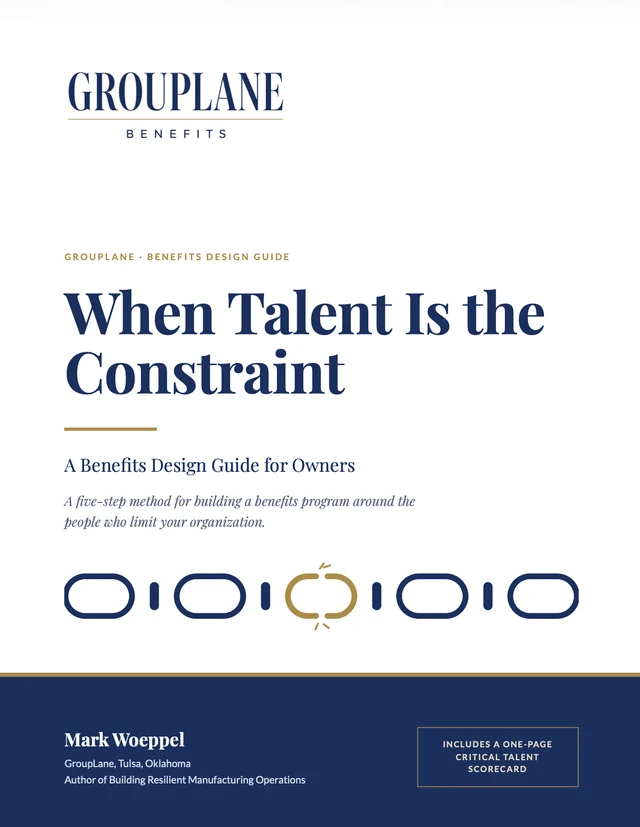
Free guide
When Talent Is the Constraint: A Benefits Design Guide for Leaders
A five-step process, a case study, and a one-page Critical Talent Scorecard. 13 pages. Free.
Get the free guideStart with your people
Most plans are renewed on price. The first question should be about your people.
Most renewal meetings focus on the plan’s cost, how much to shift to employees, and whether to raise the deductible. Those questions matter, but they come second. First, ask which people the plan needs to retain.
Some roles in your company can’t be filled in a few weeks: the licensed electrician, the certified welder, and the charge nurse. When one of these positions is vacant, work waits. Replacing one employee often costs half to twice their annual salary. If this year’s renewal just came in high, read what to do when your group health renewal jumps.
The method
Five steps.
Identify
Identify the roles that are critical to your business.
Exploit
Put your best people in those roles and give them a reason to stay.
Subordinate
Make renewal, budget, and workload decisions that protect them.
Elevate
Build an offer that wins the people you need to hire.
Explain
Make sure your people understand what they have.
Proof from operations
The same approach, in a Houston plant.
Welders limited output at Brown Fintube. The plant was rescheduled around them. In 90 days, on-time delivery rose from 40% to 95% or better, monthly sales grew 35%, and overtime fell 20%.
Find the critical skill and protect it first.
Pick the Core. Layer the Rest.
What we build.
Every program starts with a core plan and adds layers. Core: MEC, HRCA, or group medical. Then dental and vision. Then a voluntary layer (accident, critical illness, hospital indemnity, disability, whole life) that each employee chooses for their stage of life. Networks are matched to each location where you have employees. We handle enrollment and ongoing administration.
MEC
Minimum Essential Coverage — preventive care and ACA compliance at the lowest cost
Best for
Hourly workforces and employers meeting ACA requirements affordably
Group Medical
Comprehensive major medical coverage for your team
Best for
Companies competing for skilled talent with a full package
Dental
Cleanings, fillings, and major dental work
Best for
Rounding out any package — consistently a top-requested benefit
Vision
Exams, frames, lenses, and contacts
Best for
Low cost, high perceived value — for teams on screens or in the field
Voluntary Benefits
Accident, critical illness, hospital indemnity, disability, whole life — employee-paid
Best for
Filling coverage gaps without adding employer cost
Frequently asked questions
What is in the free benefits plan design guide?
“When Talent Is the Constraint: A Benefits Design Guide for Leaders” is a 13-page guide with a five-step process for building benefits around the people your business cannot afford to lose, a case study, and a one-page Critical Talent Scorecard.
What is benefits plan design?
It’s choosing benefits that fit your employees and your budget. We look at where your employees live, their stages of life, and what they can afford—not what an “average employee” might need.
What can a benefits program include?
A program can include medical, dental, vision, and voluntary benefits that employees pay for.
For medical coverage, we may recommend a traditional group plan, a health reimbursement arrangement (HRA) that helps employees pay for individual coverage, or a limited medical plan when appropriate.
You don’t have to offer everything at once. Many employers start with voluntary benefits alone.
What is MEC coverage, and when does it make sense?
MEC stands for Minimum Essential Coverage. It’s a limited medical plan that covers preventive care and certain other services, generally at a lower premium than a full group medical plan.
For some hourly workforces, it can be a starting point. But MEC alone usually does not meet the Affordable Care Act’s “minimum value” standard for large employers, so it is not a complete compliance solution. We explain when it fits and when you need more comprehensive coverage.
Can you offer different provider networks in different locations?
Yes. We match insurance companies and provider networks to each location, so employees have coverage that works where they live and see doctors.
How do you design our benefits plan?
We review your workforce, match local provider networks, choose the right mix of benefits, and set up online administration.
Get the free guide.
When Talent Is the Constraint: A Benefits Design Guide for Leaders.
Prefer to talk? 918.417.2070 | [email protected]
- When Talent Is the Constraint, Benefits Become Strategy
- Small Employer Contribution Strategy: How Much of the Premium to Pay
- How to Design a Group Health Plan That Pays Back
- How to Design Employee Benefits Package That Works in Tulsa
- Custom Employee Benefits for Small Business
- Benefits That Improve Employee Retention in Tulsa
- How to Reduce Employee Turnover With Benefits
- What a company under 50 employees can actually offer
- Small business health insurance in Oklahoma