Group versus individual health coverage: which one fits your company
A renewal comes in higher than you budgeted. The increase comes out of raises, the next hire, or the equipment you planned to replace. Most owners can plan around a high number when they know it early. The annual renewal rarely tells you in time.
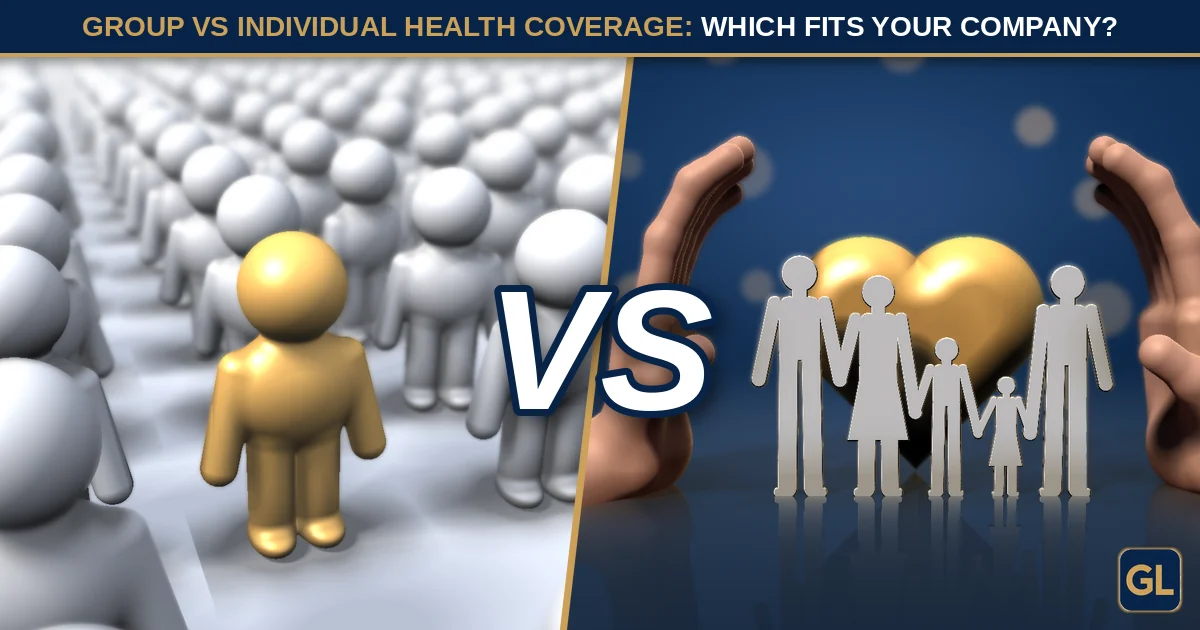
For most employers, offering health insurance has meant buying a group plan and accepting whatever the renewal says. Since 2020, employers have had a second option. The company can give each employee a fixed monthly allowance to buy individual health insurance and reimburse the premium tax-free. The choice between group and individual coverage is a choice about who sets next year’s health budget: the carrier or you.
A group plan buys one contract for everyone.
In a group plan, the company buys a single policy that covers every eligible employee, and the company decides how much of the premium to pay.
For a company with up to 50 employees in Oklahoma or Texas, the carrier sets rates for its small-business pool and adjusts them for your employees’ ages, where they live, and tobacco use. Your own claims do not move the number. With more than 50 employees, or on a level-funded plan, your claims start to matter.
The most common type of group plan is still a broad-network plan, known as a preferred provider organization. It buys a wide choice of doctors and hospitals, the full range of major medical care, and predictable costs once the deductible is met. It also carries a higher premium than narrower designs.
Group plans have real strengths. One plan is simple to explain, everyone shares the same network, and the employer controls the design. When you can fund it and your people use it, a group plan is hard to beat. The tradeoff is the renewal. The benefits consultancy Mercer projected that total health benefit cost per employee would rise 6.7% in 2026, the largest increase in 15 years, pushing the average above $18,500.
An ICHRA funds individual coverage at a cost you set
The individual option has a formal name: an Individual Coverage Health Reimbursement Arrangement, or ICHRA. An ICHRA is an employer-funded arrangement that reimburses medical costs tax-free. The company sets a monthly allowance for each employee. Employees buy individual health insurance through the government Marketplace or directly from an insurance company, and the company reimburses premiums up to the allowance.
This is full major medical coverage. Under the federal employer guide, every qualifying plan must meet federal requirements for preventive care, prescriptions, hospital care, and an annual cap on out-of-pocket costs. Short-term plans, fixed-indemnity plans, and other add-on coverage do not qualify. Each employee chooses the plan, network, and deductible, owns the policy, and can generally keep it after leaving.
Allowances can vary by class of employee (full-time, part-time, seasonal, salaried, hourly, by location, and other classes the rules allow), by age, and by family size. The oldest employee’s allowance can be no more than three times the youngest’s. Within a class, everyone gets the same terms, and you cannot offer a class a choice between the group plan and the allowance.
Two tax points favor employees. Through a cafeteria plan, an employee can pay the part of an individual premium above the allowance with pre-tax dollars, but only for a plan bought directly from an insurance company; Marketplace premiums cannot be paid pre-tax. And starting in 2026, bronze and catastrophic individual plans qualify for a health savings account, so a younger, healthier employee who uses a premium-only allowance to buy a bronze plan can also save pre-tax for medical bills.
Three conditions decide whether individual coverage fits
First, your employees have real choices where they live. Individual plans are sold county by county. A 2026 KFF analysis of Marketplace insurers found 15 insurers selling plans in Texas, while 165 U.S. counties have only one, up from 93 the year before. Check the plans in the counties where your people live before you commit.
Second, the allowance must leave your employees better off. Many people who buy their own coverage receive a premium tax credit, which is a federal subsidy based on household income. An employee who accepts the allowance gives up that credit. If the allowance is affordable, the employee cannot keep the credit even by turning the allowance down. If the allowance is unaffordable, the employee can turn it down and keep the credit. For 2026, affordable means the employee’s cost for the least expensive self-only silver plan where they live, after the allowance, is no more than 9.96% of household income; for 2027, the IRS has set the limit at 10.22%. For a lower-wage employee, a modest allowance can be worth less than the subsidy it replaces. Run the numbers for your lowest-paid people first.
Third, employees need help choosing. Individual coverage lets each employee pick a plan, network, and deductible that work well for someone who wants a specific doctor, but it can overwhelm someone who has never bought insurance before.
If those conditions are weak, keep the group plan or look at other structures. If they are strong, price an ICHRA against your group plan before you renew.
What the company takes on with an ICHRA
If an ICHRA looks attractive after those three checks, the next question is administration. The model gives the company budget control, but it also adds notice, verification, and reimbursement duties.
The company must give each eligible employee written notice at least 90 days before the plan year begins. For a January 1, 2027 start, that deadline was October 3, 2026. The plan year does not have to begin in January; an April 1, 2027 start requires notice by January 1, 2027.
The company must also confirm that each covered person is enrolled in qualifying individual coverage or Medicare, and keep a record of every reimbursement. The allowance is itself an employer health plan under federal benefits law. It needs a written plan document and a plan summary for employees; federal continuation coverage rules apply at 20 or more employees; a small per-person federal research fee is due each year; and an annual Form 5500 filing is required at 100 or more participants. Companies with about 50 or more full-time employees must offer an allowance large enough to count as affordable, or they may face a federal penalty.
Many employers hand the notices, enrollment verification, filings, and reimbursements to an outside administrator. We handle that work as part of benefits management.
Companies with fewer than 50 employees that offer no group plan have a simpler choice: an allowance with annual dollar caps set by the IRS and lighter rules. Our research on health benefits for companies under 50 compares these options.
The retention result depends on the enrollment conversation
Health coverage keeps people. Brigitte Madrian’s 1994 study in the Quarterly Journal of Economics found that workers with employer health coverage were about a quarter less likely to change jobs than comparable workers without it.
Employees can only value what they understand. A group plan puts that burden on one enrollment meeting. An ICHRA multiplies it, because every employee makes a separate purchase. An employee who chooses with someone walking through the networks, the deductibles, and their own doctors ends up with coverage they would give up by leaving. An employee left alone with a Marketplace website often picks the lowest premium and finds the deductible later. Under either structure, enrollment is where the retention return is won or lost.
Compare both on one page before you decide.
Ask for your group renewal and an ICHRA priced on the same employee census. For each, you need the company’s monthly cost, each employee’s cost by coverage tier, the deductible, and whether your employees’ doctors are in network.
Some companies split the difference: a group plan for full-time employees and an allowance for part-time or seasonal staff. When the split is full-time versus part-time, salaried versus hourly, or by an area smaller than a state, each class offered the allowance must meet a minimum size: 10 employees for a company with fewer than 100, 10% of headcount from 100 to 200, and 20 for companies with more than 200. A 40-person company with six part-timers cannot give only those six an allowance while everyone else stays on the group plan.
We design programs for employers with 25 to 150 employees across Oklahoma, Texas, and neighboring states, and we will build that comparison from your census.
Contact us or call 918.417.2070.
Education only. Not a quote, an offer of coverage, or tax or legal advice.